
UHV Store of Switzerland - Ultra High Vacuum Technology
🔩 Precision Screws for UHV, High-Temperature & Oxidizing Environments
🔩 Precision Screws for UHV, High-Temperature & Oxidizing Environments
Couldn't load pickup availability
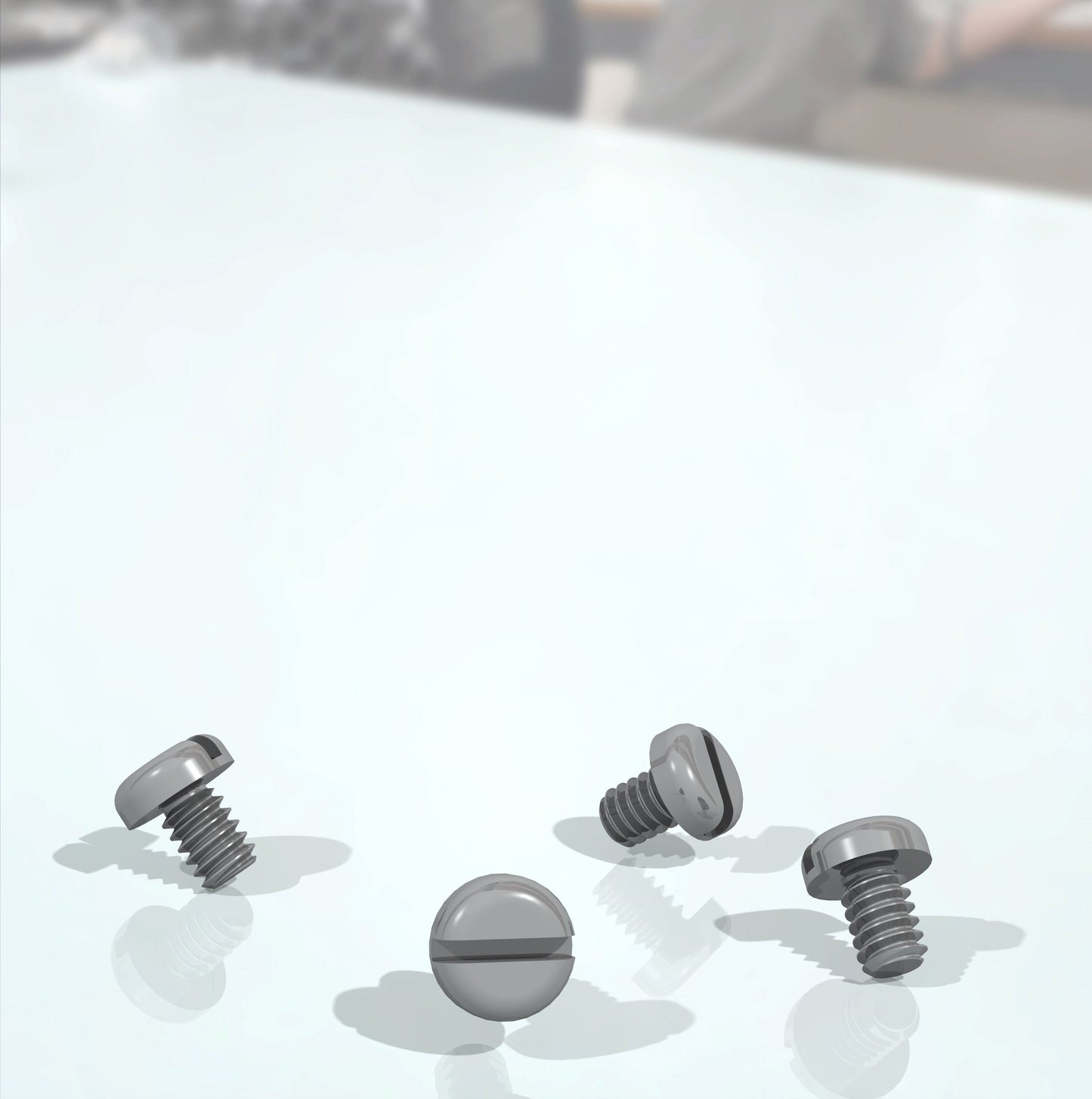
These small precision screws are designed for demanding scientific, vacuum, cryogenic, and high-temperature applications. Typical uses include sample mounting, manipulators, heating stages, cooling assemblies, vacuum chambers, and other precision hardware where cleanliness, dimensional stability, and material compatibility are critical.
A wide range of materials is available to optimize thermal performance, chemical resistance, magnetic behavior, and mechanical properties for specific experimental requirements.
High-Vacuum Cleaning for UHV Use
All screws are delivered HV-cleaned and packaged to minimize surface contamination. During handling, installation, and load-lock transfer, vacuum components are inevitably exposed to air. For this reason, a final in-situ bake-out is recommended to achieve true ultra-high vacuum conditions below 10⁻⁹ mbar.
The supplied HV-cleaned condition provides a technically sound starting point for reliable UHV operation.
Material Options
Stainless Steel (AISI 304 / 316L)
Typical Properties
- Good mechanical strength
- Excellent corrosion resistance
- Cost-effective and widely available
- Usually non-magnetic when fully annealed
Applications
Stainless steel is the standard choice for room-temperature vacuum systems and general scientific hardware. When properly cleaned and baked, it performs well in HV and UHV environments.
Because of its relatively high thermal expansion and low thermal conductivity, stainless steel is generally not preferred for strongly heated or cryogenic sample stages.
Molybdenum (Mo)
Typical Properties
- Melting point: ~2623 °C
- High thermal conductivity
- Very low thermal expansion
- Paramagnetic
- Excellent vacuum compatibility
Applications
Molybdenum is one of the most commonly used materials for UHV sample holders, heating stages, and high-temperature fixtures. It combines excellent dimensional stability with efficient thermal coupling and very low outgassing.
Ideal for UHV, HV, and inert-gas environments.
Tantalum (Ta)
Typical Properties
- Melting point: ~3020 °C
- Excellent corrosion resistance
- Paramagnetic
- High ductility and toughness
Applications
Tantalum is particularly well suited for chemically aggressive or oxygen-containing environments where refractory metals may be susceptible to oxidation. It offers excellent corrosion resistance and remains mechanically robust over a wide temperature range.
A preferred choice for chemically sensitive experiments and reactive process environments.
Tungsten (W)
Typical Properties
- Melting point: ~3422 °C
- Highest thermal conductivity among available materials
- Lowest thermal expansion
- Paramagnetic
Applications
Tungsten provides the highest temperature capability of all available materials and is ideally suited for directly heated samples, high-power heating stages, and extreme thermal environments.
Due to its high stiffness and brittleness, careful handling is recommended, particularly for small screw sizes.
Alloy 601 (DIN 2.4851 / UNS N06601)
Typical Properties
- Nickel-chromium high-temperature alloy
- Excellent oxidation resistance
- Good mechanical strength at elevated temperatures
- Good manufacturability
Applications
Alloy 601 is designed for operation in oxidizing atmospheres, including air and oxygen-containing process environments. It forms a stable chromium oxide layer that provides long-term protection against oxidation.
Suitable for furnace systems, high-temperature process equipment, and heated assemblies exposed to air or oxygen.
Alloy 602 CA (DIN 2.4633 / UNS N06025)
Typical Properties
- Premium nickel-chromium-aluminum alloy
- Exceptional oxidation resistance
- Superior creep strength
- Excellent long-term high-temperature stability
Applications
Alloy 602 CA offers significantly improved high-temperature performance compared to Alloy 601, particularly in oxidizing atmospheres above 1100 °C. The formation of a stable aluminum oxide layer provides outstanding resistance to scaling and oxidation.
Recommended for the most demanding high-temperature applications in air, oxygen, combustion atmospheres, and thermal processing equipment.
Material Selection Guide
| Requirement | Recommended Material |
|---|---|
| Room-temperature vacuum applications | Stainless Steel |
| UHV sample holders and fixtures | Molybdenum |
| Chemically aggressive environments | Tantalum |
| Maximum temperature capability | Tungsten |
| High-temperature operation in air or oxygen | Alloy 601 |
| Extreme high-temperature oxidation resistance | Alloy 602 CA |
Practical Considerations
In vacuum systems, cold welding and galling can occur when identical materials are used for both the screw and the threaded component. To reduce this risk, dissimilar material combinations are often preferred, such as molybdenum screws in tantalum components.
For demanding applications, UHV-compatible dry lubricants such as molybdenum disulfide (MoS₂) may also be considered.
Conclusion
The optimal screw material depends on the operating environment and application requirements.
- Stainless Steel: General-purpose vacuum applications
- Molybdenum: Excellent UHV performance and thermal stability
- Tantalum: Superior chemical resistance
- Tungsten: Maximum temperature capability
- Alloy 601: High-temperature use in oxidizing atmospheres
- Alloy 602 CA: Extreme oxidation resistance and long-term thermal stability
Selecting the appropriate material ensures reliable performance, long service life, and optimum compatibility with the intended scientific or industrial process.