emios GmbH
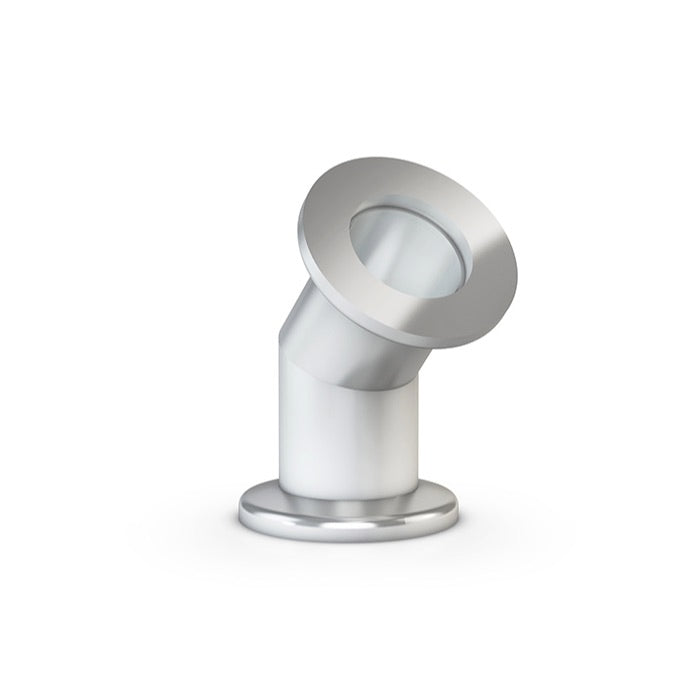
KF Elbow 45°
KF Elbow 45°
Couldn't load pickup availability
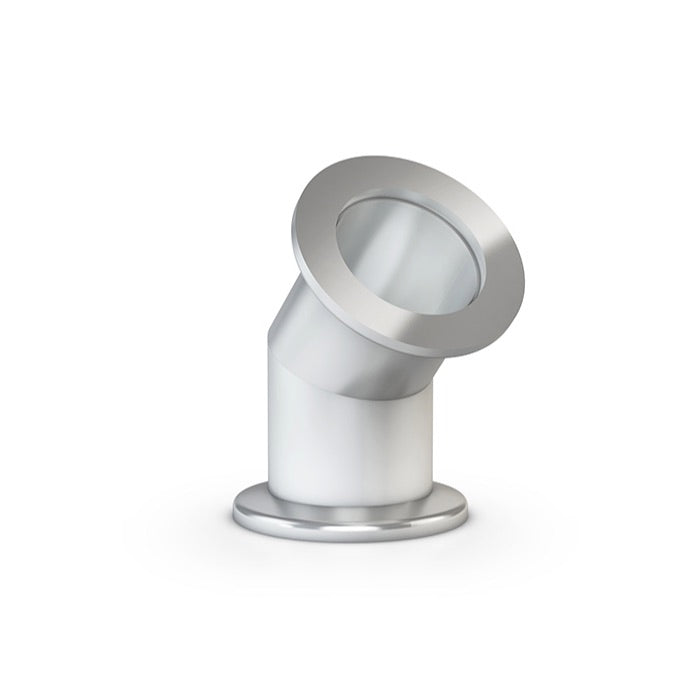
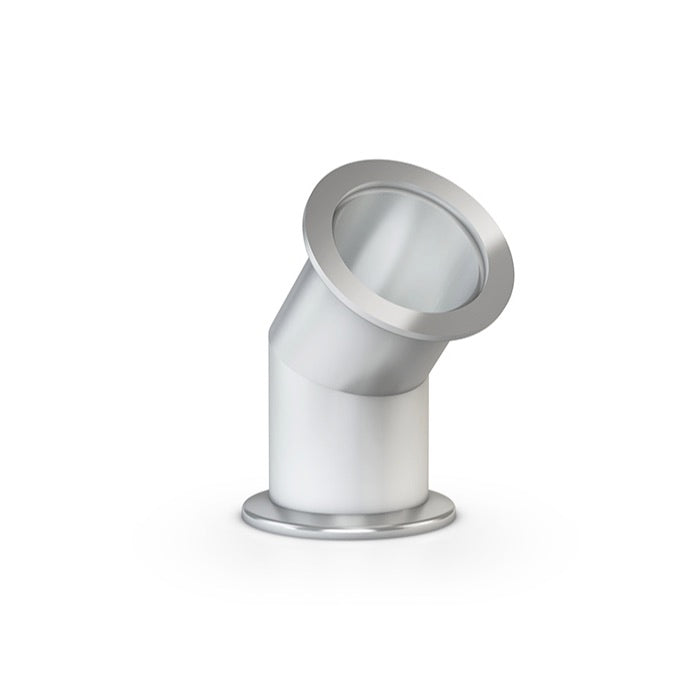
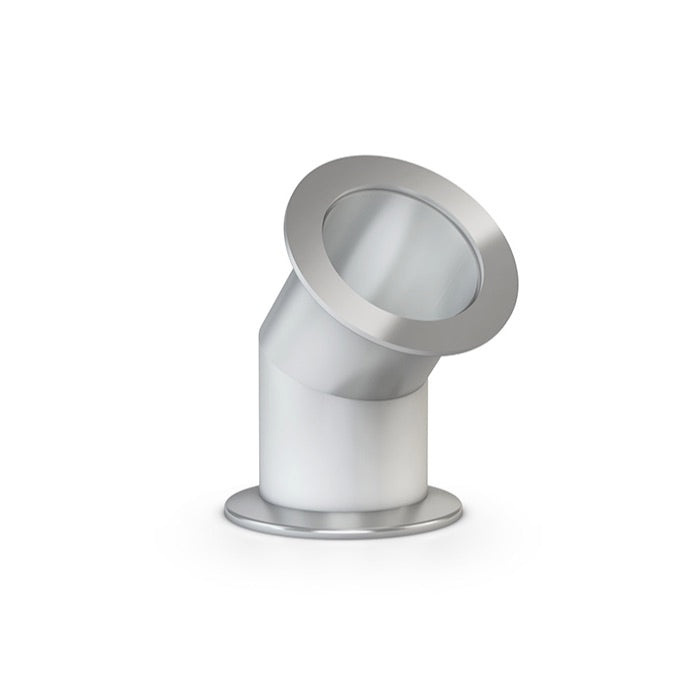
The KF Elbow 45° provides a reliable solution for changing the direction of vacuum piping by 45° while maintaining a standard ISO-KF flange connection. Its angled design enables flexible routing of vacuum lines where a gradual change in direction is required.
Manufactured from high-quality stainless steel or aluminium, the elbow offers robust construction for vacuum and high-vacuum applications. Compared with a 90° elbow, the 45° configuration allows a less abrupt change in flow direction, making it suitable for vacuum system layouts where space, accessibility, and efficient piping arrangements are important.
Available in stainless steel 1.4301 (AISI 304), 1.4404 (AISI 316L), and aluminium 3.2315 (EN AW-6082), providing material options for different vacuum system requirements.
Technical Specifications
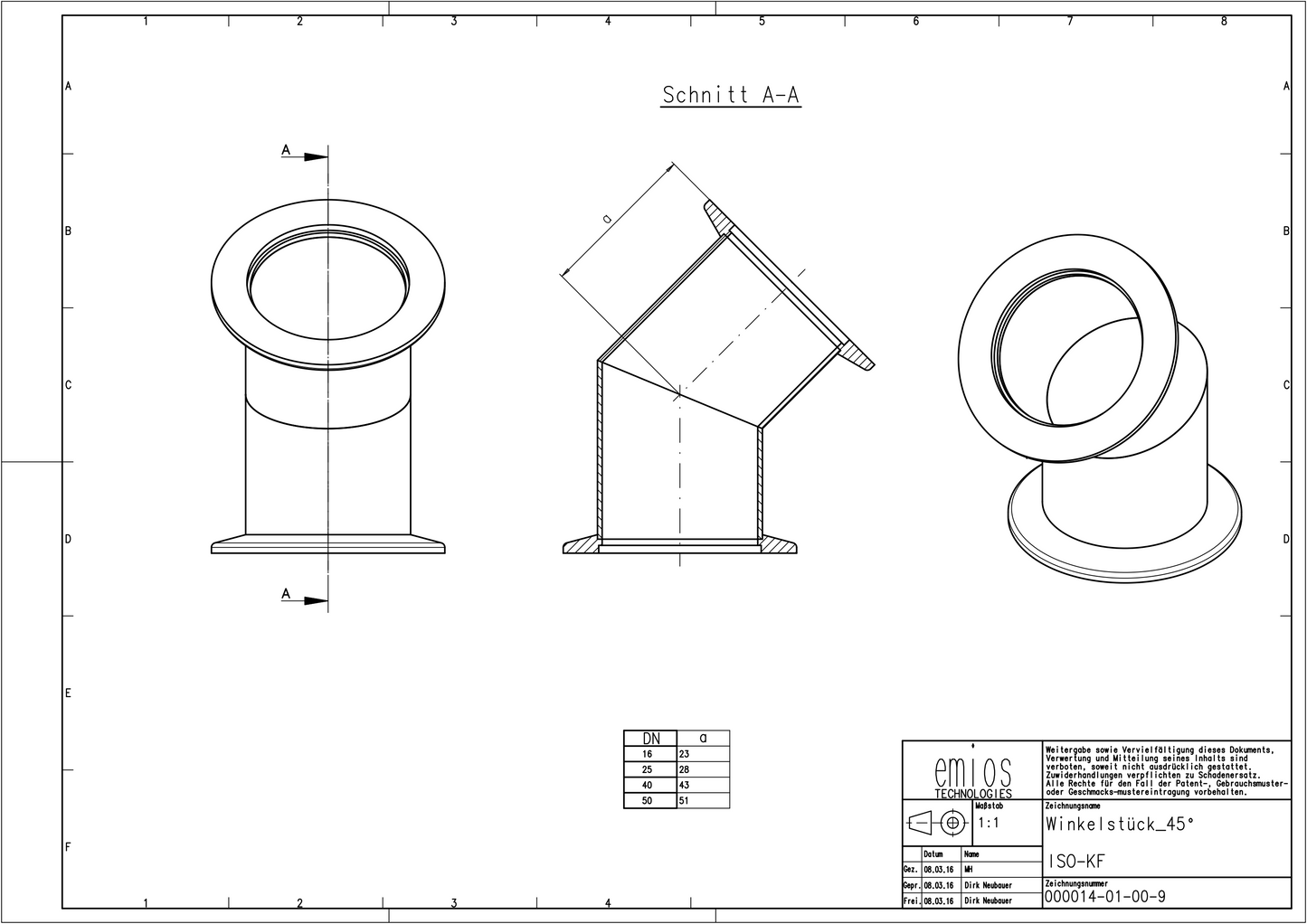
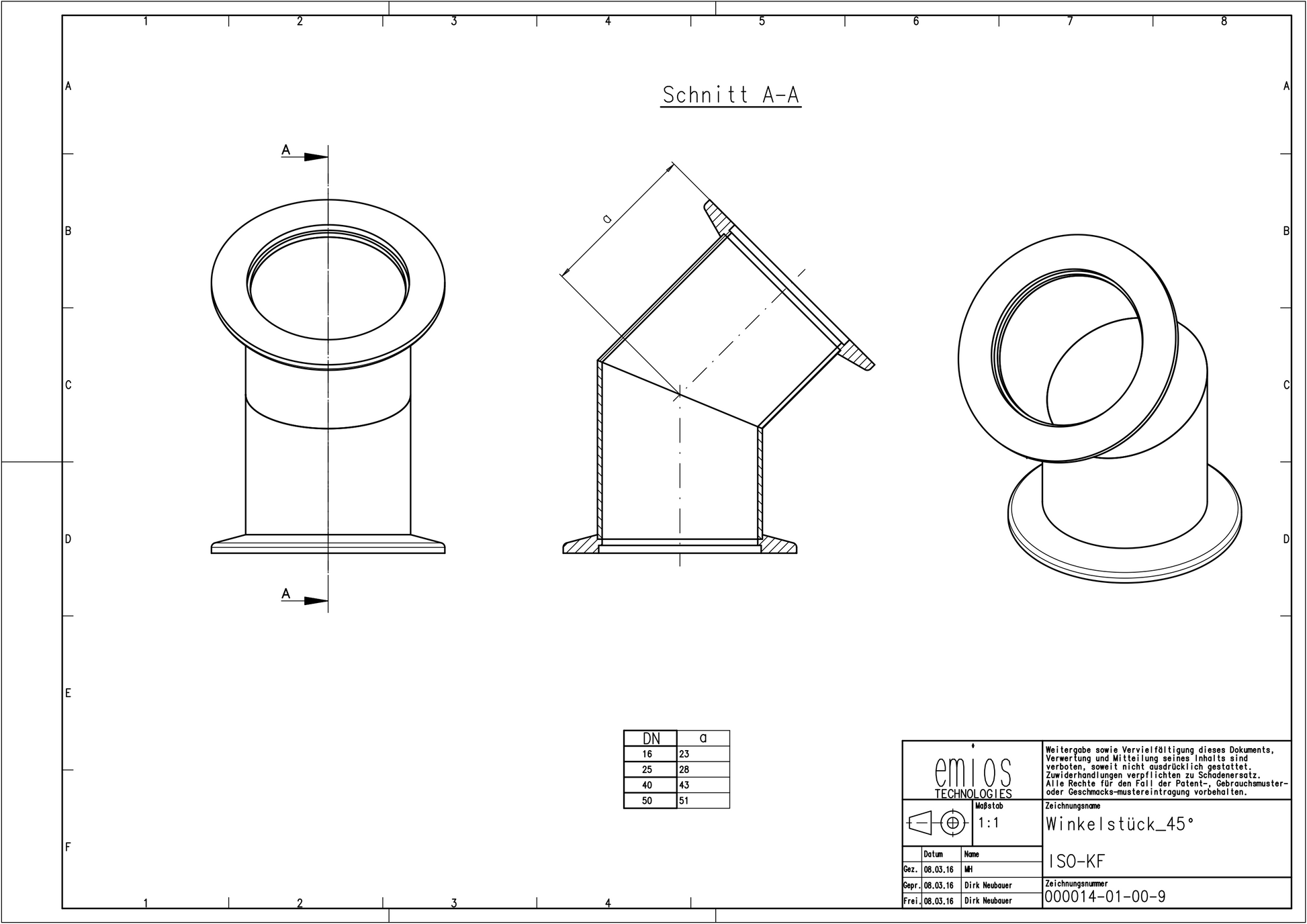
Flange Sizes: DN16, DN25, DN40, DN50 KF
Materials: Stainless Steel 1.4301 (AISI 304), Stainless Steel 1.4404 (AISI 316L), Aluminium 3.2315 (EN AW-6082)
Flange Connection: ISO-KF (QF / NW)
Configuration: 45° elbow with two KF flange connections
Bend Angle: 45°
Sealing: Compatible KF centring rings with elastomer O-ring seals
Applications
Suitable for vacuum chambers, pumping systems, vacuum manifolds, laboratory vacuum equipment, and industrial vacuum installations requiring angled piping connections.
The 45° elbow is particularly useful for routing vacuum lines around obstacles, adjusting the alignment of vacuum components, and creating compact vacuum piping arrangements without additional adapters.
Installation and Compatibility
Compatible with standard ISO-KF flange connections of the corresponding nominal sizes. Each connection requires a suitable KF centring ring with O-ring seal and a KF clamp.
Compatible KF Centring Rings & Seals and KF Clamps are available separately.
For applications requiring a 90° change in direction, the KF Elbow 90° is also available.
The achievable vacuum pressure and operating temperature depend on the selected sealing components and operating conditions.